
Blog | What Are T Levels? A Guide for Students & Parents
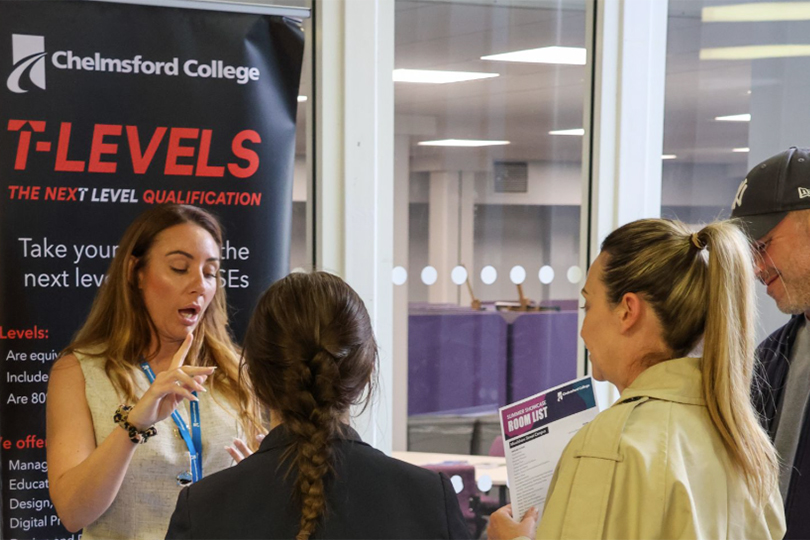
Choosing what to study after GCSEs is an important decision. If you have an interest in a particular career area and want to combine classroom learning with workplace experience, a T Level could be a suitable next step.
At Chelmsford College, our T Levels cover subjects ranging from business and information technology to construction, childcare and health. This guide explains how they work and what students and parents should consider before applying.
What Is a T Level?
A T Level is a two-year Level 3 qualification studied after GCSEs. Developed with employers, it combines industry knowledge with technical skills and an industry placement.
Students typically spend around 80% of their programme learning at college and 20% gaining experience with an employer. This allows you to explore how the things you learn in lessons apply in a working environment.
Unlike choosing several separate A level subjects, a T Level focuses on one career area. You develop an understanding of the wider sector before building skills in a particular specialism.
What Is a T Level Equivalent To?
A full T Level is equivalent in size to three A levels and carries UCAS points. Your overall result is graded as Pass, Merit, Distinction or Distinction*.
This makes it a substantial qualification that can support progression into further study. However, equivalence does not mean every university course accepts every T Level. Check the subject and grade requirements for any degree you are considering before choosing your programme.
How Do Industry Placements Work?
An industry placement is a required part of your T Level. Most involve at least 45 days with an employer, although some subjects require longer placements.
Depending on your course and employer, you may attend on individual days throughout the programme or complete blocks of placement time. You will agree learning goals with your tutor, with progress reviewed alongside your placement manager.
At Chelmsford College, our dedicated Industry Placement Team supports students and employers throughout the process. Placements help you practise technical skills, build confidence and understand workplace expectations. They can also help you decide which roles and working environments interest you. Employers are not required to pay students, although they can choose to do so.
Who Might a T Level Suit?
A T Level may suit you if you have a clear interest in a sector but want to continue studying at college while gaining experience.
It includes classroom study, independent work and assessment, and practical learning. For example, our Management & Administration T Level includes exams, an employer-set project and an occupational specialism assessment.
Entry requirements vary. Management and Administration requires four GCSEs at grades 4–9, including English and Maths. There are no tuition fees if you start the programme before turning 19. Always check your chosen course’s requirements before applying.
For parents, a useful starting point is discussing your child’s interests and preferred learning style. Consider whether they want to explore one industry in depth and are ready to commit to both college attendance and a placement.
Which T Levels Can You Study at Chelmsford College?
Our T Level provision includes:
• T Level in Finance (Specialism in Insurance Practitioner), Level 3
• T Level in Legal Services, Level 3
• T Level in Management & Administration (Specialism in Team Leadership and Management), Level 3
• T Level in Marketing, Level 3
• T Level in Education & Childcare (Specialism in Early Years Educator), Level 3
• T Level Design, Surveying & Planning for Construction (Specialism in Surveying and Design), Level 3
• T Level Technical Qualification in Media, Broadcast & Production, Level 3
• T-Level in Design & Development for Engineering & Manufacturing
• T Level in Health (Specialism in Supporting Adult Nursing), Level 3
• T Level Digital Support & Security, Level 3
• T Level in Digital Software Development, Level 3
Visit our T Levels page to explore course details, specialisms and entry requirements.
What Can You Do After a T Level?
Depending on your subject, results and the relevant entry requirements, you could progress to:
• Skilled employment.
• A higher or degree apprenticeship.
• University or another higher education programme.
For example, our Construction T Level can support progression towards construction-related degrees, apprenticeships and trainee or technician roles. These routes have their own requirements, so progression is not automatic.
Find the Right Route for You
You do not need to make the decision alone. Explore our T Level courses, then speak to our Careers Team about your interests and future plans.
Call 01245 293031 or email careersadvicezone@chelmsford.ac.uk for guidance on choosing your next step.